Kaomoji meanings: what (´・ω・`), orz and other famous faces say
Updated October 13, 2026 · 5-minute read · 5 sections
Someone answers your joke with (´・ω・`). Sad? Sulking? Mildly let down? Kaomoji meanings are easier than they look once you know where to look: at the eyes first, then the little marks around them.
How to read any kaomoji in three glances
- Eyes. They carry the main feeling. Closed curves ^ ^ are smiling, T T and ╥ ╥ are streams of tears, ° ° and o o are wide open in shock,  ̄  ̄ are flat and unimpressed, x x means knocked out.
- Marks beside the eyes. A ; is a sweat drop (nervous, awkward), * or 〃 are blushing cheeks, ゚ and ✧ are sparkle, ♡ is love.
- Arms and props. ヽ ノ thrown up mean joy, ┐ ┌ out to the sides mean “whatever”, m … m is hands on the floor in a bow, ┻━┻ is a table, usually on its way through the air.
Kaomoji are read upright, which is why the eyes matter more than the mouth – Wikipedia’s article on kaomoji makes the same point, and notes that the semicolon sweat drop comes from manga. A mouth only fine-tunes the face: ω reads as cute or smug, 益 as gritted teeth, ▽ as an open laugh.
Famous kaomoji and what they mean
The meanings marked with † follow the Eastern emoticons table in Wikipedia’s list of emoticons; the rest are the common reading. The last column is how I use each face.
| Face | Name | Meaning | When to use it |
|---|---|---|---|
| (^_^) | Smile | Joyful † | A friendly sign-off that fits anywhere |
| (^o^) | Open laugh | Excited † | Good news |
| (*^_^*) | Blushing smile | Normal laugh †, with blushing cheeks | Warm thanks, a bit shy |
| (^_-) | Wink | Wink † | A joke or a hint |
| (>_<) | Squeezed eyes | Troubled † | “Ugh, I messed up” |
| (T_T) | Crying | Sad, crying † | Real or comic sadness |
| (-_-;) | Sweat drop | Nervous, embarrassed † | Awkward moments |
| (・・;) | Sideways sweat | Nervous, embarrassed † | Caught out |
| (o_o) | Wide eyes | Surprise, shock † | Quiet disbelief |
| (*_*) | Starry eyes | Amazed † | Something impressive |
| (´・ω・`) | Shobon | Snubbed or deflated † | Mild disappointment, a little sulky |
| m(_ _)m | Bow | Kowtow as respect, or dogeza for apology † | Sorry, or a deep thank-you |
| orz | Kneeling figure | Despair † | Total defeat, usually comic |
| (ಠ_ಠ) | Look of disapproval | Disapproval † | Silent judgement |
| (╯°□°)╯︵ ┻━┻ | Table flip | Flipping the table in rage | Comic outrage |
| ┬─┬ノ( º _ ºノ) | Putting the table back | Calm reply to a flip | Talking someone down |
| ヽ(´ー`)ノ | Relief | Peace of mind † | After a deadline |
| ¯\_(ツ)_/¯ | Shrug, shruggie | Mellow, shrug † | “Who knows?” |
| ( ͡° ͜ʖ ͡°) | Lenny face | Mostly mischief † | Teasing – with friends only |
| uwu | uwu | Joy or cute † | Soft, playful chat |
| (=^・^=) | Cat | Cat † | Cats, or being cat-like |
| ʕ•ᴥ•ʔ | Bear | Bear † | Cute, cuddly |
| (-_-) | Flat face | Sleeping † | Tired, or deadpan |
| (=_=) | Heavy eyes | Tired † | Fed up, worn out |
| ( ̄ー ̄) | Grin | Grinning † | Smug, “I told you so” |
| (x_x) | Knocked out | Dead person, fainted † | Exhausted, overwhelmed |
Wikipedia files both table faces under “Table flip”; the tidy ┬─┬ノ( º _ ºノ) is the classic answer to the angry one. Most of these are under Popular on the kaomoji page, with their names, one tap to copy.
What does orz mean?
orz is not a word – it is a picture. Read the three letters as a person seen from the side: o is the head, r is the arms and back, z is the folded legs. Someone on their hands and knees, head hanging. Wikipedia lists it among variants such as OTZ with the meaning despair.
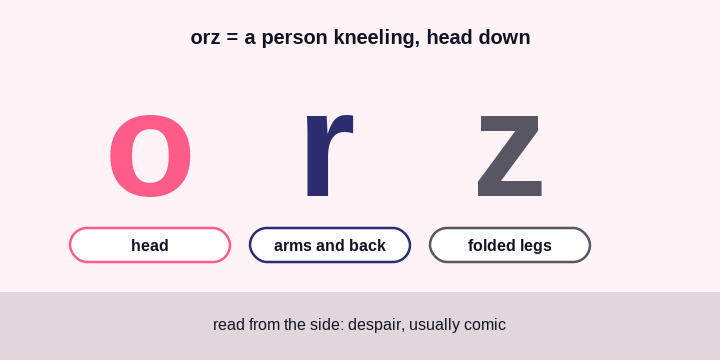
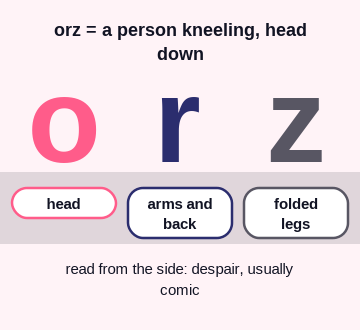
In use it is almost always comic: you failed a quiz, lost a match, missed a sale by a minute. If a friend sends orz, they want sympathy and a joke, not advice.
Faces that are easy to misread
(^_^;) is not happy
Add a semicolon to a smile and it becomes an awkward smile with a sweat drop – the face you make when someone shows you a bad drawing. If you mean plain joy, leave the ; off.
(´・ω・`) is not crying
Shobon has no tears. It is a drooping, deflated face – “aw, okay then”. If someone is truly upset, (T_T) or (╥﹏╥) fits better.
m(_ _)m is not always sorry
The bow covers respect as well as apology, so it works for a big thank-you as much as for an apology. Context decides.
( ͡° ͜ʖ ͡°) is not neutral
The Lenny face, which Wikipedia traces to the Finnish board Ylilauta, suggests mischief and often innuendo. Keep it out of work chat. It also uses combining marks that some older phones draw as boxes.
( ̄ー ̄) is not a warm smile
The flat eyes make it a smug grin. Use it when you were right, not when you are pleased for someone.
Where the famous names come from
Many of these faces grew up in Japanese online culture. Shift JIS let users build faces from kana, kanji, Greek and Cyrillic, and the 2channel boards turned them into whole characters and borrowed letters from other scripts – the Kannada ಠ of the disapproval face is one. The table flip, says Wikipedia, went global after crossing into Western culture through 4chan. That is why a face you see in a Western meme often has a Japanese grandparent.
If you want to build a face with your own mix of eyes and mouth, the Maker tab on the kaomoji page assembles one from parts. And if you are wondering when a face beats an emoji, read kaomoji vs emoji vs emoticons.
Questions and answers
What does (´・ω・`) mean?
It is shobon: a deflated, let-down face – Wikipedia gives “snubbed or deflated”. It is milder than crying.
What does orz mean?
It is a person on hands and knees seen from the side – o is the head, r the arms and back, z the legs. It means despair, usually in a joking way.
What does m(_ _)m mean?
A deep bow: hands on the floor and the head lowered. It is used for apologies and for respectful thanks.
What does ಠ_ಠ mean?
The look of disapproval – a flat, staring face for silent judgement. Its eyes are the Kannada letter ಠ, which some older phones show as boxes.