Kaomoji vs emoji vs emoticons: what's the difference?
Updated October 13, 2026 · 5-minute read · 8 sections
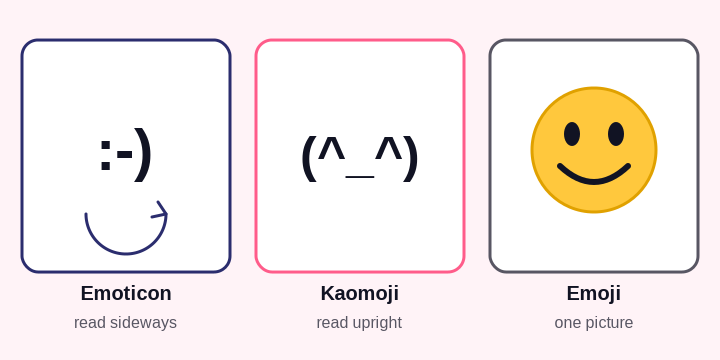
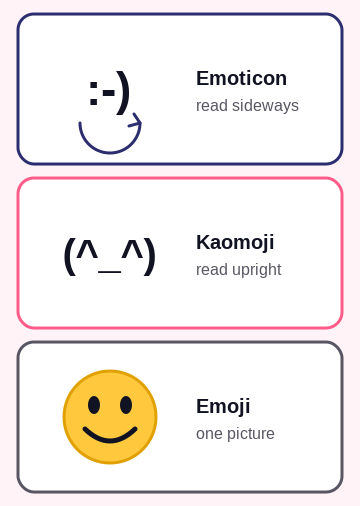
An emoji is one picture character that your device draws for you. A kaomoji like (^_^) is a face you build from several ordinary characters and read upright. An emoticon like :-) is its Western cousin, read with your head tilted. Three kinds of face, three different ideas.
Emoticons: the sideways smile
Scott Fahlman proposed :-) on Carnegie Mellon University’s computer science bulletin boards, as a way to mark jokes; his own page, Smiley lore, tells the story and the exact date. He suggested :-( for serious posts, and it soon came to mean displeasure. The face lies on its side: eyes, nose, mouth, from left to right. The mouth does most of the work – :-) happy, :-( sad, :-P cheeky.
Kaomoji: the upright face
Japanese users went another way. On ASCII NET, an early Japanese online service, faces were written to be read without tilting your head, and Yasushi Wakabayashi is credited with the original kaomoji, according to Wikipedia. Here the eyes carry the feeling: (^_^) smiles, (T_T) cries, (o_o) stares. Because Japanese computers could mix kana, kanji, Greek and Cyrillic, kaomoji grew far richer than :-) – arms ヽ ノ, sweat drops ;, blushes *, whole scenes such as (╯°□°)╯︵ ┻━┻.
Emoji: one character, one picture
An emoji is not built from parts at all. It is a single character with its own code in Unicode, and the font on the reader’s device draws it as a picture. The word is Japanese too: 絵 e (picture) plus 文字 moji (character). It only looks related to “emotion” by coincidence, Wikipedia’s emoji article notes. The best-known early set was Shigetaka Kurita’s, made for NTT DoCoMo’s i-mode phones, before Unicode took emoji in as standard characters.
Because the device draws the picture, the same emoji can look different from phone to phone. Wikipedia’s example is the pistol emoji, which Apple redrew as a water gun – the sender saw one thing, the reader another. A kaomoji has the opposite strength: what you type is what they get, as long as their font has the characters.
Side by side
| Emoticon | Kaomoji | Emoji | |
|---|---|---|---|
| Example | :-) | (^_^) | one picture character |
| Made of | 2–3 keyboard characters | several characters, often Japanese | one Unicode character |
| Read | sideways | upright | as a picture |
| Feeling carried by | the mouth | the eyes | the drawing |
| Who decides the look | the reader’s text font | the reader’s text font | the reader’s emoji font |
| Length | 2–3 characters | 5–15 characters is typical | one character |
| Typical trouble | apps may turn it into an emoji | Markdown eats \ _ *, rare letters show as boxes | looks different on other devices |
| Range of feelings | small | huge, including actions and scenes | large, and grows with new Unicode versions |
The length row matters more than you would think. ¯\_(ツ)_/¯ is 9 characters and (╯°□°)╯︵ ┻━┻ is 12 – fine in a chat, a squeeze in a 15-character game name. The kaomoji page Maker shows the character count of every face you build.
When I use which
- Kaomoji when I want tone, not a sticker: a sheepish (^^ゞ, a deflated (´・ω・`), a mock-furious table flip. They feel personal and playful, and they work in places where emoji look out of place, such as game chat, code comments and display names.
- Emoji when the reader scans fast – a thumbs-up on a work message, a heart on a photo. One picture, read in a split second.
- Emoticons when I want to look a little retro, or when I write somewhere that only takes plain keyboard characters.
Two habits save trouble. In Discord, Reddit and other Markdown apps, copy kaomoji with Markdown-safe copy on, or ¯\_(ツ)_/¯ arrives one-armed. And if your reader might be on an old phone, avoid faces with rare letters such as ಠ or ᴥ – the ⚠ mark on the kaomoji page flags them for you.
Three quick ways to tell them apart
- Move the cursor through it. In a kaomoji the cursor stops between the eye, the mouth and the bracket, because each is its own character. An emoji is one picture, so there is nothing inside it to step through.
- Change the font. Paste the face into a document and switch fonts. A kaomoji or an emoticon changes shape with the text; an emoji keeps its colourful picture from the emoji font.
- Look for colour. Kaomoji and emoticons take the text colour – black in an email, white on a dark theme. Emoji have their own colours.
Why kaomoji are still everywhere
Emoji took over everyday chat, yet kaomoji never went away, and I think the reasons are practical. First, range: a single emoji shows a face, but a kaomoji shows a face doing something – shrugging, bowing, flipping a table, hugging (づ。◕‿‿◕。)づ. Second, tone: a kaomoji reads like handwriting, a little personal, a little playful, where an emoji can feel like a stock sticker. Third, reach: kaomoji are plain text, so they go where pictures can’t – usernames, plain-text emails, code comments, terminal chats.
The price is the two problems from the table: Markdown apps that eat backslashes and underscores, and rare letters that turn into boxes. Both are easy to manage once you know about them, which is why the copy tool on the kaomoji page has a switch for one and a warning mark for the other.
Can you mix them?
Yes, and people do: (ノ◕ヮ◕)ノ*:・゚✧ is a kaomoji with sparkles thrown from text symbols, and many kaomoji end in a ♡ or ☆ – text symbols, not emoji pictures. If you mix in real emoji, remember the emoji part depends on the reader’s device while the text part depends on their font. A face that is mostly plain characters stays the most predictable.
To learn what the famous faces actually say, read Kaomoji meanings; to type them without a website, see how to type kaomoji.
Questions and answers
Is a kaomoji an emoji?
No. An emoji is a single picture character; a kaomoji is a face made of several ordinary text characters, read upright, like (^_^).
Which came first, emoticons or kaomoji?
Scott Fahlman’s sideways :-) came first, on Carnegie Mellon’s bulletin boards. Upright kaomoji appeared a few years later on Japan’s ASCII NET.
Why does my kaomoji look different on another phone?
Its characters are drawn by the reader’s font. If the font lacks a rare letter, such as ಠ or ᴥ, the phone shows a box instead.
Do kaomoji work everywhere emoji work?
Almost: they are plain text. Watch out for Markdown apps, which hide \, _ and *, and for strict length limits in names.